
Meta Description:
Outlander Season 7 features romance, war, heartbreak and long-awaited momentum as Jamie and Claire remind fans why the Frasers still rule the series.
Introduction
Stretching over almost two years and sixteen episodes, Outlander Season 7 finally arrives—and for longtime fans, the journey is mostly worth it.
It is undeniable that the show has made some creative mistakes over the past few years. Seasons 5 and 6 often felt like extended set-up, moving chess pieces around carefully and never delivering the emotional payoff that once made the historical fantasy drama must-watch television. But Season 7 brings something that’s been missing for a while: urgency.
This latest chapter, set against the backdrop of the American Revolution and the deeply personal stories of the modern day, serves as a reminder to viewers why the Fraser family was one of television’s most beloved clans in the first place. It’s not perfect, far from it, but when it works it delivers that old Outlander magic in spades.
The Revolution Is Personal at Last
One of the great strengths of Season 7 is that it plunges Claire Fraser and Jamie Fraser right into the middle of political chaos instead of keeping them on the sidelines of history.
Claire opens the season with a terrifying prospect, being accused of the murder of Malva Christie and facing possible execution. It’s a compelling setup that immediately raises the stakes of the story. Meanwhile, Jamie is forced to make choices that bind his family’s survival to the revolutionary cause.
This is Outlander in its wheelhouse, a show built on history crashing into personal relationships.
Here, what works particularly well is that the war never comes off as background decoration. Every alliance, every uniform, every decision has personal ramifications.
History buffs will be rewarded with details throughout the production, from American symbols of yore to the transformation of battlefields that will make the era feel alive.
The MacKenzies wage a different kind of war
Frasers have to face the realities of 18th century warfare, Brianna MacKenzie and Roger MacKenzie are coping with a completely different set of challenges, after landing in the 1980s.
There are no muskets, redcoats or political rebellions in this story—but it has tension of its own.
It adds an emotional layer to the season that Brianna is trying to find a place in what should be a familiar world but isn’t. There’s ambition, frustration, and the quiet realization that “modern life” does not necessarily mean “easy life.”
Unfortunately, this is also where the season sometimes falls short.
This year’s Brianna is one of the more action-heavy arcs, and yet she’s often sidelined just when her storyline seems primed to explode. It’s one of several moments where the season promises emotional depth but doesn’t always stick around long enough to explore it.
New Faces inject surprise energy
One of the quiet victories of Season 7 is how it expands the ensemble without losing focus.
William Ransom turns out to be one of the most interesting new characters of the season, showing up as a strong presence in no time. His new friendships, divided loyalties and emotional struggles breathe new life into the series at just the right time.
Then there’s the shifting triangle of relationships between Ian, William and Rachel, a web of relationships that adds romance, jealousy and youthful uncertainty without being forced.
This is the kind of subplot that could easily have been filler, and instead develops into one of the season’s most emotionally arresting threads.
And when Lord John Grey comes back to the fore, the show has a whole other level of charisma instantly.
His return isn’t just a nostalgia play, it actively raises the stakes of the drama.
Jamie and Claire Still Have This Thing
No matter how many new characters are introduced, no matter how many timelines the story throws into the mix, one fact is undeniable:
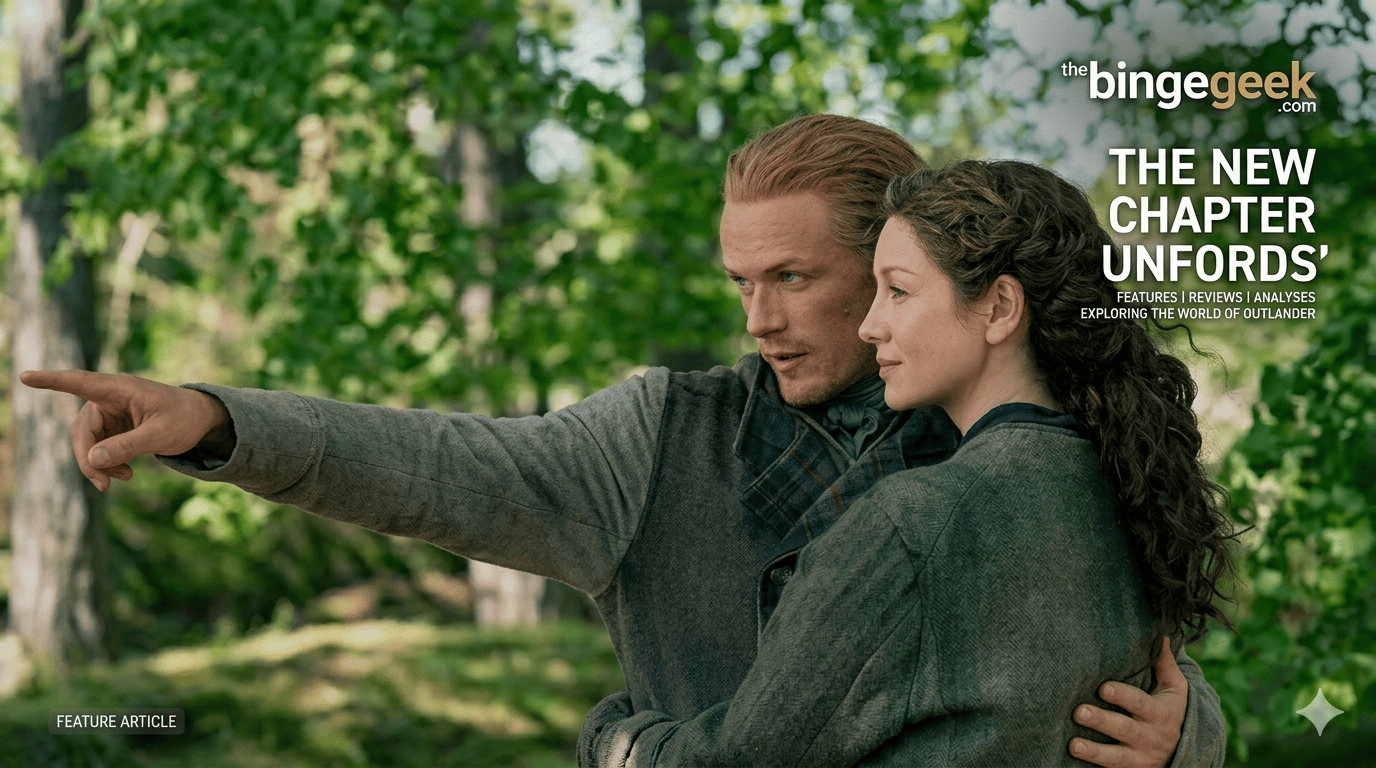
Jamie and Claire are still Outlander.
The series has arguably toned down the kind of passionate intimacy that defined much of its early reputation, but Season 7 shows those moments were never the only reason audiences cared.
Now it’s the silent moments that hurt the most.
A view across a field of battle. A joke shared in the midst of chaos. A conversation that carried decades of history.
Caitríona Balfe and Sam Heughan are still the kind of chemistry most TV couples could only dream of. The makeup can add wrinkles, the wigs can add gray, but nothing hides the emotional pull between these two characters.
After seven seasons, they are still electric.
Beautiful Craftsmanship Keeps the World Allured
If there’s one thing Outlander hardly ever fails at, it’s presentation.
Season 7 maintains the show’s impressive technical consistency.
Every era, be it period garb, huge battles, colonial homes or 20th century look, seems carefully crafted.
The score still packs an emotional punch, the sets are lived-in, and the action sequences have a scale to them without losing sight of character.
Where historical authenticity can make or break immersion in a genre, Outlander still sets the very, very high bar.
Pacing problems haven’t completely gone away.
Despite its merits, Season 7 is not without familiar frustrations.
Some storylines drag out far too long, and emotionally charged developments sometimes go by with surprisingly little reflection.
It’s a weird disbalance.
Some of the more subtle story beats are given more time, while some of the major emotional turning points can feel a little rushed.
This uneven rhythm doesn’t ruin the experience — but it does keep the season from feeling truly great from start to finish.
It’s almost ironic that some of the best moments are when the show just trusts its characters, rather than trying to stretch its mysteries.
That Finale Leaves More Questions Than Answers
Season 7 generally culminates in a satisfying, often emotional, finale.
And then the finale takes a sudden turn in a different direction.
The final cliffhanger is a shocking twist with one of the season’s breakout characters that feels intentionally provocative and controversial, without giving anything away.
Whether it will become meaningful drama or just shock value will be up to Season 8.
It’s the one note that clouds what has otherwise been a strong finish, right now.
And yet, it’s impossible to not want answers right away.
And perhaps that is the point.
Character Highlights
Claire Fraser Is the Emotional Anchor
Claire’s resilience, intelligence and quiet defiance provide a grounding for some of the strongest material of the season.
Jamie Fraser Remains TV’s Ultimate Romantic Hero
Even in war, even under pressure Jamie doesn’t lose the warmth that had audiences fall for him.
William Could Be Franchise’s Future
Season 7 quietly makes William one of the most interesting characters to watch moving forward—and frankly, it works.
Lord John Gray Steals Each Scene
Some characters are back. Lord John comes.
There is a difference.
Final Thoughts and Predictions for Season 8
While season 7 isn’t immune to the pacing problems that haunted the middle years of Outlander, it does something arguably more important – it gets viewers emotionally invested again.
And with William’s future hanging in the balance and unresolved family tensions, plus one big finale shock to be unpacked, Season 8 has all the ingredients for something special.
If the writers keep this new energy and fine-tune the storytelling, the final chapter could be the send-off this epic deserves.
Final Verdict
8.5/10
Outlander Season 7 may not have perfect pacing, but its emotional core, rich performances, and renewed sense of adventure make it the show’s strongest outing in years. Jamie and Claire are unforgettable, and the next chapter suddenly seems unavoidable.