
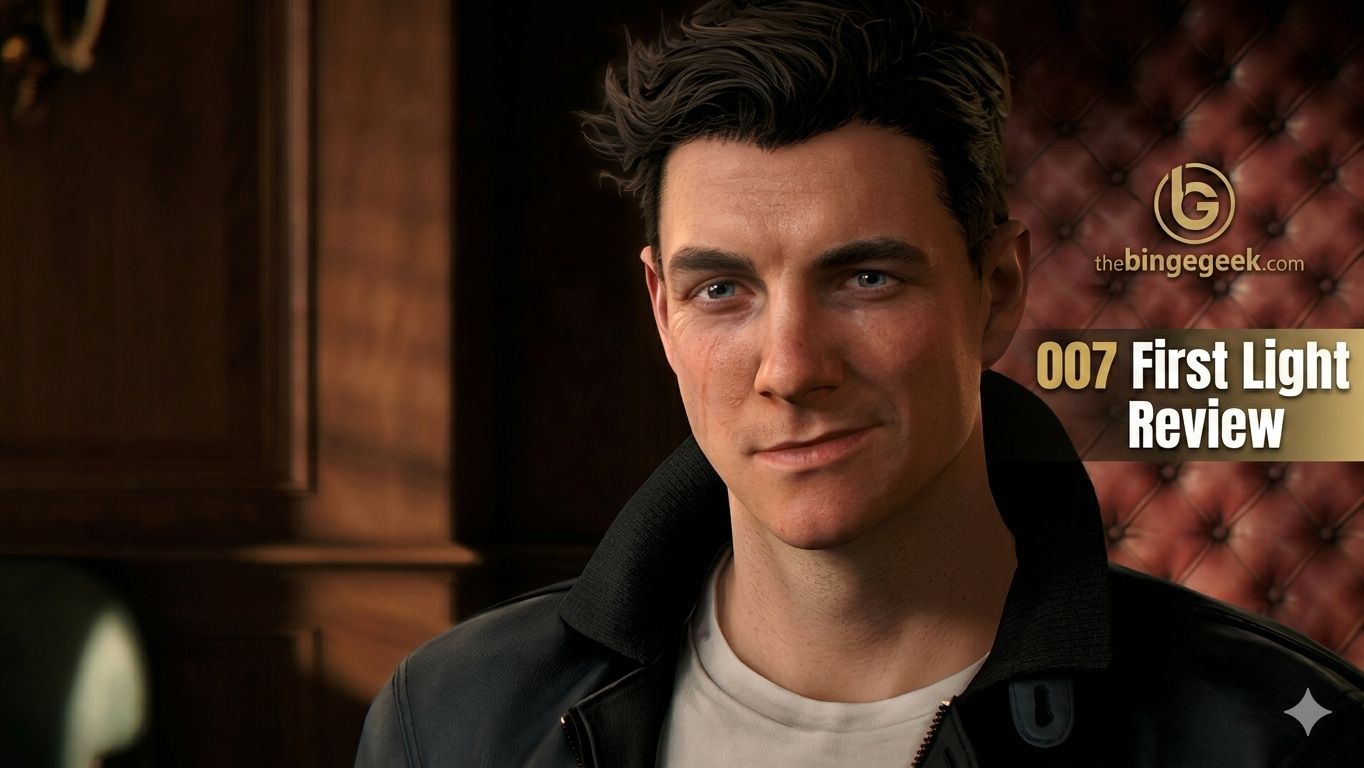
For decades, James Bond has been one of the most recognizable characters in entertainment. In novels, films or video games, the legendary British spy has always been a cocktail of sophistication, danger and globe-trotting adventure. Bond is not just an agent, he’s a fantasy. He’s the guy who walks into impossible situations with confidence, outsmarts powerful enemies, and somehow walks away with the mission accomplished and his tuxedo intact.
With 007 First Light, developer IO Interactive aims to bring Bond back with an original origin story that takes us into the early days of his career. It sounds like a perfect match on paper. After all, IO has already proven its espionage chops with the Hitman series. Sadly, while 007 First Light nails the visual style and cinematic flair of the franchise, it can’t quite recreate the feeling of freedom and empowerment that makes Bond such a compelling character.# Good Story, Bad Villains
The story is set when James Bond is younger, before he has achieved 00 status. Following the failure of a disastrous military operation, Bond is recruited into MI6’s newly resurrected elite program and finds himself caught up quickly in a conspiracy involving rogue operatives, private mercenary groups and a powerful artificial intelligence system called THEIA.
Traveling from country to country, Bond’s investigation slowly turns into a larger threat involving a wealthy tech mogul and his troubled son. The story successfully delivers many of the elements fans expect from a Bond adventure, including betrayals, assassinations, international intrigue and high stakes missions.
But it lacks great villains. First Light never introduces an enemy capable of leaving a lasting impression, though Bond stories are often remembered for their unforgettable antagonists. The central villain in the film is not charismatic or threatening enough to make the conflict interesting. Bond’s relationship with his mentor Greenway is much more compelling than the actual villain plot.
It’s that emotional connection that delivers some of the game’s best moments and could have arguably done with more attention throughout the campaign.# Adventure Suffers from Poor Pacing
One of the biggest problems with 007 First Light is its pacing. The game takes a long time to build its world before it starts racing toward what seems like a climax halfway through the story.
Later chapters lose momentum and take weird detours into side adventures that water down the urgency of the main plot. Some of the missions are fun on their own, but the placement of them creates a disjointed experience that struggles to maintain narrative tension.
Ironically, one of the most solid Bond-esque missions comes surprisingly late in the campaign. The chapter finally falls into the espionage fantasy, letting Bond socialize, manipulate targets, and charm his way through situations instead of using brute force. Unfortunately, by the time the game gets to this point it has spent too many hours focusing on more conventional action-adventure gameplay.## The Big Lie of Selection
At first glance, 007 First Light seems to give the player a lot of agency. The dialogue options, mission strategies, and interactive discussions imply that your decisions will impact the events.
Most of these choices really don’t matter much in reality.
No matter what choices you make, conversations seem to end up the same. Story events follow predetermined paths, and multiple mission sequences play out the same way no matter how players go about them.
Even the moments that are meant to be important turn out to be cosmetic and not meaningful. This can lead to players eventually abandoning any attempt to engage with the decision making systems at all, when they come to understand how little control they actually have over the story.
It is one of the biggest disappointments of the game, as the Bond universe is naturally suited to player-driven espionage. The game is often leading players to one outcome rather than rewarding creativity.# Best gameplay is investigation and stealth
Most missions follow a familiar format. Players start by gathering intelligence, infiltrating secure areas, and tracking targets, before erupting into action-heavy finales.
The investigation segments are typically the best part of the experience. Searching environments , eavesdropping on conversations and finding clues help create the feeling of being a secret agent .
The Instinct system is an especially interesting mechanic. Successful actions over time fill a resource meter which can later be used to manipulate situations. Bond can outthink his way past guards, create diversions or get into places that are otherwise off limits.
The system is a welcome addition to missions, and often as close to the game’s representation of Bond’s resourcefulness as it gets.
Unfortunately, the idea doesn’t quite work out. The game hints at more involved infiltration mechanics like disguises and social stealth, but it never develops those ideas into meaningful gameplay systems.# Combat Yields Mixed Results
It works, but the fighting is rarely anything special.
Gunplay is serviceable, but weapon balancing is inconsistent. Light weapons such as handguns and rifles tend to be more useful than heavier ones, and there are awkward moments when the use of firearms is restricted during missions.
Enemy AI performs well in firefights, frequently attempting to flank players or flush them from cover. Environmental interactions add variety, allowing players to use objects in the world during encounters.
But stealth is not sophisticated. Enemy awareness can easily be exploited, allowing you to kill large numbers of guards using repetitive tactics. Sections like this are painfully easy for players used to modern stealth games.
Melee combat is often more fun than shooting or stealth, interestingly. There are some fun moments with environmental takedowns and close-quarters encounters, though some attacks can be abused to trivialize encounters.## Traversal Looks Old School
The platforming in the game takes clear notes from franchises like Uncharted and Tomb Raider. Unfortunately they rarely have the same sense of excitement or discovery.
There are very obvious lines on these routes that do not leave much room for exploration or problem solving. Most of the traversal sections have the player jumping between obvious paths and highlighted handholds, rather than having to analyze the environments themselves.
The end result is a system that works well enough, but lacks the thrill and satisfaction of the best of the genre.Gadgets and Driving Never Work
No Bond adventure is complete without gadgets and First Light has some of the signature spy tools. They do their job on missions, but few are all that memorable.
Devices appear to be interchangeable for the most part and their uses are often constrained to specific contexts rather than facilitating experimentation.
Driving sections are similarly restricted. The handling of the vehicle is just OK, and the interactions with the environment often break the immersion. Cars soak up damage inconsistently, pedestrians act unrealistically, and various set-piece sequences prioritise spectacle over believable gameplay systems.
The game has cinematic moments but those moments often feel disconnected from the mechanics that support them.# Experience Carried by Outstanding Presentation
Where 007 First Light always wins is in its presentation.
The graphics are great all throughout the game. The locales are richly detailed, the environments beautifully designed, and the globe-trotting adventure feels appropriately cinematic. Whether it’s urban centers, remote facilities or scenic international destinations, it’s hard to go wrong.
The soundtrack is just as good. The orchestral score is often inspired from classic Bond films and has the sophistication and excitement associated with the franchise. Some sequences really feel like the entrance to a bond movie, with good musical direction and good atmosphere.
Some of the NPC behavior can occasionally break the immersion, but overall the production values are impressive from start to finish.## Last Word
007 First Light gets the look and sound of James Bond right, but doesn’t quite nail what makes the character special.
The story is fun, the presentation is top notch and there are moments of brilliance throughout the campaign. But shallow choices, no stealth mechanics, uneven pacing and restrictive mission design prevent the game from fully realizing the fantasy of being 007.
Fans of cinematic action-adventure games will probably find lots to like, especially with the strong production values and globe-trotting story. But those wanting a more in-depth spy simulation with meaningful choices and creative problem solving may be disappointed.
007 First Light eventually manages the tuxedo trick, but beneath the slick surface is an unexpectedly generic action game that never quite earns its license to thrill.#Rating: 7 out of 10