
Meta Description: Meta description:
Colony’s ending, zombie hive-mind twist, survivor betrayals and why talking is the deadliest weapon in the film.
Introduction:
Yeon Sang-ho’s Colony comes with the kind of premise that immediately grabs the attention of horror fans: a zombie outbreak contained within a single high-rise building. But the film is far more interested in human behavior than infected monsters, beneath all the frenetic action and grotesque body horror.
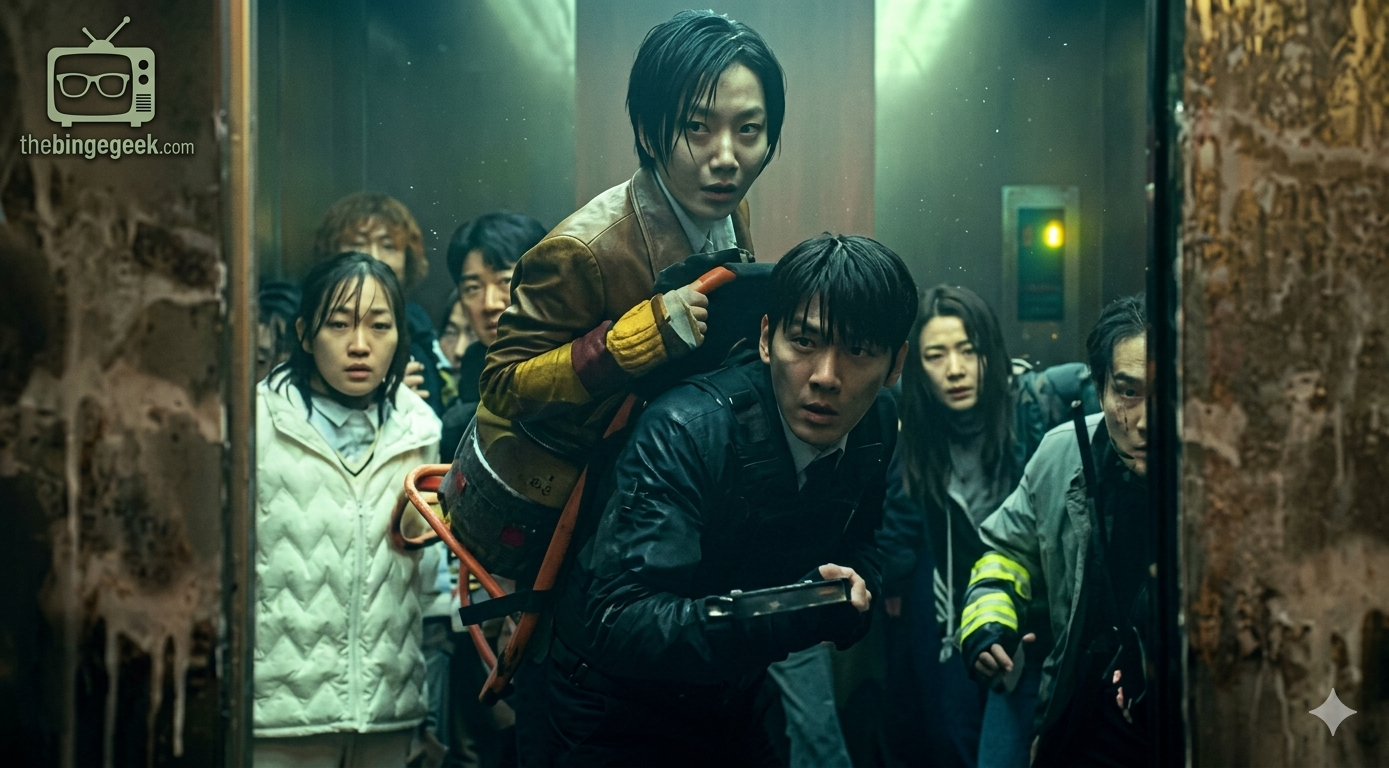
Colony is almost entirely set inside the claustrophobic Dongwoori Building, transforming a biotech conference into a nightmare where paranoia spreads faster than the virus. The film starts out as a survival thriller, but slowly morphs into a meditation on miscommunication, resentment and the deadly fantasy of total emotional transparency.
And while the film does feature a handful of nerve-shredding moments, its ending is divisive, in part because of its ambitious ideas and in part because of the increasingly messy choices that almost every character makes.
A Zombie Virus of Collective Consciousness
The infected in Colony are not your standard zombie, they are connected in a strange hive-mind. Chain Bio CEO Kang Woo-cheol rapidly contracts the virus, and it spreads quickly through the building, but the creatures do not simply hunt out of instinct.
They learn.
They disseminate information via the slime-like mucus they secrete, so they can evolve whenever they get new information. This makes them adaptable predators, not mindless corpses. They mimic voices, coordinate attacks, even exploit emotional vulnerabilities.
That one change completely alters the tone of the movie. The terror is no longer in being chased by monsters. It is the knowledge that the monsters are listening.
The disgraced scientist behind the outbreak, Dr Suh Young-chul, eventually takes over the infected after being bitten himself. The hive mind allows him to see and hear through the zombies , so the whole building is basically his surveillance network .
The most disturbing idea this film raises is that privacy itself disappears.
Why the Survivors Start Turning on Each Other
The only time the survivors are alive for most of the movie is when they work together. When selfishness is introduced, the whole thing goes to hell.
Officer Lee Bong-seok is one of the most clear examples of this collapse. When Lee finds out that Suh could be the key to a vaccine, he focuses on getting him instead of protecting the other survivors. He leaves Choi Hyeon-hee in the control room which indirectly leads to her death.
That moment is a turning point for her brother Hyeon-seok, whose grief turns to rage. From then on, survival is no longer enough, revenge is his driving force.
The movie continually demonstrates how panic can destroy rational thought. Each character starts making decisions out of fear, guilt, or self-preservation, rather than logic.
This spiral is neatly encapsulated in So-eun’s betrayal of Na-yoon. The two girls had exhibited signs of emotional cruelty earlier, but when the instinct to survive kicked in, that cruelty turned deadly. One of the darkest ironies in the movie is when Na-yoon sacrifices So-eun in order to save herself, only to be immediately killed by the newly infected So-eun.
Safety is never betrayal in Colony. It only puts off death.
Dr. Suh doesn’t want to end humanity, he wants to “fix” it
Suh is more interesting than a normal horror villain because he truly believes he’s solving a human problem.
His hate for the world is born of humiliation and loss. Chain Bio stole his research. His father died in an investigation. He had come to believe that misunderstanding was the root of every human tragedy.
The philosophy of Suh is scary because there is some truth buried in it.
The characters do not communicate properly throughout the film:
People hide details.
The survivors don’t trust each other.
Panic kills empathy.
Warnings are ignored.
Violence is the product of emotional assumptions.
Suh ends by saying that individuality itself is defective. His answer is a common consciousness in which no one can lie, or hide jealousy, or misunderstand the aims of another.
His twisted utopia is the infected.”
Ironically, though, Suh never really understands people either. But he reduces all of humanity to a system that can be fixed by forcing connection, ignoring the fact that emotional complexity and personal boundaries are part of what makes us human in the first place.
The Ending’s “Ant Mill” Sequence Explained
The climax occurs outside the building as the outbreak spreads to the city. Now, Dr. Gong Seol-hee and Se-jeong finally learn that the infected depend on Suh’s centralized control.
Kill him, and the whole network goes down.
Followed by one of the film’s strangest, but most memorable ideas. Se-jeong turns the zombies’ hive behavior against them, leading the infected to a single target with a slime-covered coat. The creatures begin to circle endlessly confused, like an ant mill where ants get trapped following each other in loops until exhaustion kills them.
This forces the infected to regress mentally, losing the intelligence they have gained from collective learning.
Suddenly the monsters are primal again.
Se-jeong uses fake human imagery near a burning bus to lure the zombies and trap Suh inside the flames. His death seems to kill the outbreak, instantly paralyzing the infected.
Colony, though, won’t offer a satisfying wrap-up.
The final hint that one zombie is still roaming suggests the virus may have gone beyond Suh’s control entirely.
Se-jeong’s character arc is more complex than it seems at first
At first, Se-jeong appears to be the moral center of the film. But the narrative softly criticizes her rigidity throughout.
She doesn’t get subtlety, she thinks in absolutes. Suh says one of the reasons he fell from grace was his lack of empathy for his father’s plight. Whether that is a fair charge is open to some debate but the film is clearly anxious to make the audience question her black and white view of the world.
In the end, Se-jeong only succeeds when she works with Gong, not on her own.
That partnership is the film’s real counterpoint to Suh’s ideology.
Human connection is important — but not forced mind sync. Trust has to be free .
The Final Act’s divisive nature
Colony has some interesting themes but it stumbles badly in the second half.
Suddenly a lot of characters are ignoring rules that the film established. The zombies already know they can imitate voices, and pass on information. But the survivors are openly talking about plans in the presence of the infected. Military members make dumb tactical decisions over and over and some deaths feel artificially forced rather than organically realized.
It’s especially frustrating with the warehouse sequence with the fake SWAT voices, because the characters had already seen the infected mimic human speech earlier in the film.
Even Suh’s loss begs questions. If he can control the infected to that degree, why doesn’t he tell them to stop Se-jeong during the final confrontation?
These inconsistencies make what might have been a great horror film.
But the ideas in this movie are powerful enough to survive some messy execution and make it compelling.
What the End of Colony Really Means
At its core, Colony suggests failures of communication breed emotional isolation long before monsters ever appear.
The zombies are just the physical manifestation of that fear.
Every major tragedy in the story is the result of repressed emotion, selfish choice or incomplete understanding. Suh believes suffering can be eradicated by eradicating privacy and individuality but the film ultimately refutes this belief.
You can’t force a connection.
Voluntary knowledge sharing and trust are the only way the survivors move forward. Meanwhile, Suh’s obsession with absolute unity turns authoritarian and destructive.
The biggest irony in the movie is that Suh dies when he loses control of the collective intelligence that he created.
The Final Verdict
Colony is a quirky but engaging horror thriller that blends zombie mayhem with psychological and philosophical elements seldom seen in mainstream outbreak films.
The claustrophobic setting, the disturbing hive-mind concept and the emotionally charged betrayals all give rise to several unforgettable moments. While the film stumbles through its final act with frustrating plot holes and inconsistent character choices, it is still a successful and tense study of fear, distrust and emotional alienation.
Colony doesn’t quite stick the landing, but Yeon Sang-ho once again shows he knows how to use horror as social commentary.