
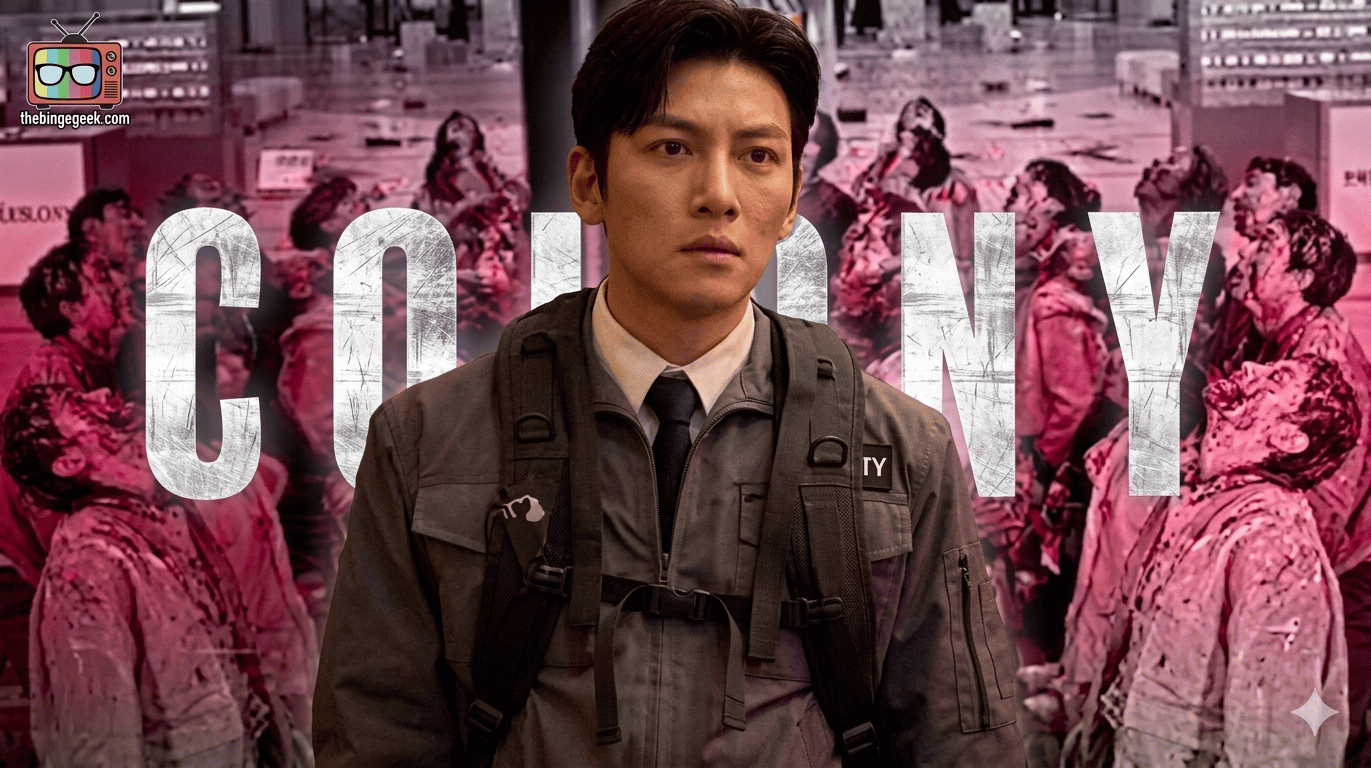
Meta Description:
Colony (2026). Tense survival horror, evolving zombies and good performances are marred by an uneven second half.
Introduction to the topic
South Korean horror still reigns supreme in the zombie genre, and Colony brings the ambition and nightmare fuel to show why. Directed by Yeon Sang-ho, the director who reinvented modern zombie movies with Train to Busan, this latest outbreak thriller replaces fast-moving trains with the claustrophobic hallways of a quarantined office tower.
But it’s not the gore and panic-driven survival sequences that make Colony stand out. The film tries something stranger, something more unsettling: zombies that think, adapt and communicate through a shared consciousness. The idea alone sets the film apart from the countless infection thrillers that moviegoers have already seen.
The result is a tense and often gripping horror experience that nearly reaches greatness before tripping over its own ambitions in the final stretch.
Corporate Tower Becomes a Nightmare
The story takes place almost entirely inside the Dongwoori Building, a massive commercial complex that is hosting a biotech conference run by Chains Bio. The setup feels dense, maybe even a bit overwhelming at first. Scientists argue about consciousness research, relationships end in uncomfortable conversations and a host of supporting characters are introduced at a breakneck pace.
Dr. Kwon Se-jeong is at the center of the story when she attends the conference but she’s still tense over her ex-husband Dr. Han Kyu-seong and his new wife Dr. Gong Seol-hee. Elsewhere in the building, a security guard agonizes over his disabled sister, teenagers fight in the cafeteria and a police officer rushes to the scene after a terrorist warning.
Then the movie blows up its central disaster.
A bitter former researcher, Dr. Suh Young-chul, infects the CEO of the company with an experimental virus, creating an outbreak that spreads through the building in minutes. From there Colony turns into a frantic survival horror of collapsing alliances, desperate escapes and ever more horrifying mutations.
The tight quarters work perfectly. Elevators turn into death traps. Hallways become hunting grounds. Every locked door is temporary.
These Zombies Are Really Different
Zombie fatigue is real, but Colony has a clever workaround:
These infected are not brainless meatheads wandering around waiting to have a bullet put in their head. They evolve all the time, almost learning from what people do. To make matters worse, they have a telepathic network for sharing thoughts, which makes them coordinated in ways that are deeply unnerving.
That one thought shifts the whole tension.
Characters can’t depend on normal rules of survival, because monsters tend to adapt too quickly. Safe areas are no longer safe. Strategies fail in surprising ways. The film keeps forcing its survivors to improvise, making many sequences unpredictable and even genuinely suspenseful.
Yeon Sang-ho avoids the usual zombie-movie beats for body horror and psychological dread. The film’s disturbing visual identity, with its white slime-covered corridors, pale-eyed infected humans and grotesque parasite-like creatures, lingers long after the credits roll.
The Cast Gives It Horror Emotional Weight
One reason Colony continues to be engaging even in its messier moments is the ensemble cast.
Ji Chang-wook and Kim Shin-rok provide a surprising amount of emotional depth to the mayhem. The frantic ways their characters try to save each other provide some of the most human moments of the film, even with all the violence and panic.
Meanwhile Koo Kyo-hwan brings sharp energy to the movie. His snarky reactions and erratic behavior add tension and some dark humor without detracting from the horror.
The film also benefits from not giving its characters obvious plot armor. Korean horror has a reputation for taking out its key players at a moment’s notice and Colony fully embraces that. There’s never a moment where even known stars are safe, and the stakes are high all the way through.
The Second Half of the Film Starts to Lose Control
Colony is full of ideas, but when it hits the second half, it struggles to keep itself in check.
The screenplay starts to lean too hard on frustrating character decisions and forced conflicts. Suddenly some survivors act like they don’t know anything about the infected and it creates problems that feel forced and not organic.
In particular, two supporting characters – the aggressive school bully and a cowardly police officer – become tiresome narrative devices. They don’t make things difficult . They make stupid choices again and again just to keep things dangerous and dramatic .
It’s a shame because the film spends so much time establishing smart survival mechanics early on. Later on, seeing the characters abandon logic takes away some of the tension.
Outside investigation into Dr. Gong Seol-hee and the virus research also feels like it’s underdeveloped. It does broaden the scope of the outbreak, but those scenes never prove as gripping as the horror unfolding inside the quarantined building.
Ironically, the film is best when it’s trapped indoors with the survivors trying to navigate the grotesque maze that the building becomes.
Yeon Sang-ho’s Direction Continues to Deliver Brutal Entertainment
Even as the writing stumbles, the direction keeps the movie watchable.
Yeon Sang-ho knows how to build momentum in tight places. Although the film is set primarily in one location, it rarely feels visually static. The action scenes are chaotic but not incomprehensible, and the horror imagery is consistently unsettling.
Production design gets a shout-out too. The Dongwoori Building morphs, little by little, from a typical corporate space into something like a living organism infected by disease and decay.
The whole film has this nasty, grimy texture to it which works absolutely perfectly for this kind of horror.
Fans of Train to Busan may be in for a surprise at how tonally different Colony is. This is not an emotional crowd pleaser built on sacrifice and sentimentality. Stranger is colder and much more about paranoia and mutation.
That creative risk makes the film memorable even when it doesn’t quite succeed.
Last Judgment
Colony is frighteningly close to being one of the best zombie movies in recent memory. Its claustrophobic setting, evolving and committed performances, give the genre a much-needed creative jolt.
But uneven writing and frustrating late-stage decisions prevent it from the emotional and narrative precision of Yeon Sang-ho’s best.
But there’s enough originality, tension and nightmare-inducing imagery here to make Colony worth watching for horror fans, especially those craving a zombie movie that tries something genuinely different.
3.5/5
A brash & refreshingly nasty zombie thriller that loses its footing near the finish line but remains gripping for most of its run-time.