
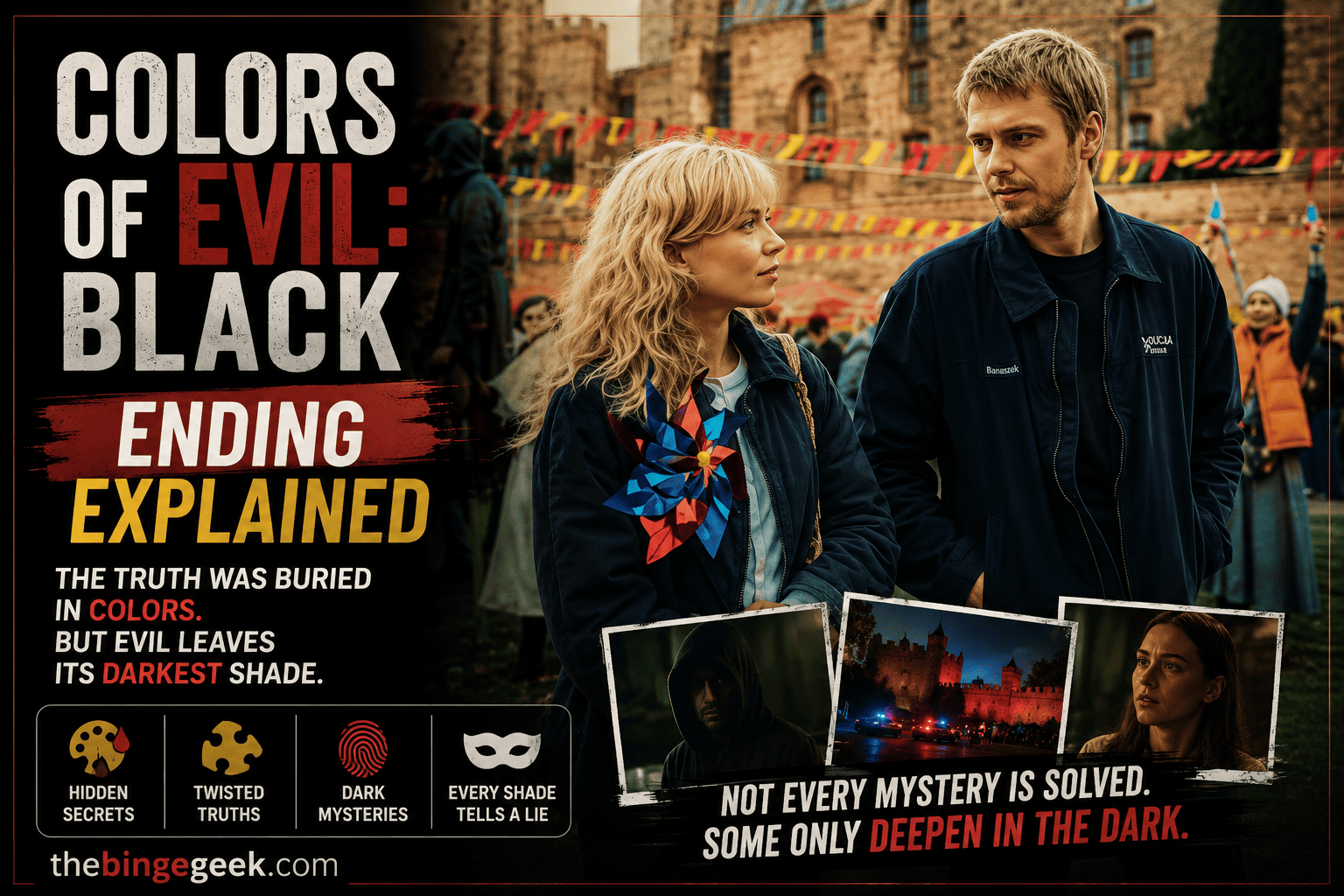
Colors of Evil: Black isn’t your typical mystery where you wait until the very end to find out who the killer is. Instead, the film is much more concerned with how an entire community can be complicit in the hiding of horrific crimes behind reputation, tradition and fear.
The story is set in the sleepy Polish town of Trulocz and follows Prosecutor Leopold Bilski, who is sent there as a form of professional punishment. Almost immediately he becomes suspicious of the town’s remarkably clean criminal history. What seems to be a peaceful community soon reveals a disturbing history that many residents have been trying to conceal for years.The Disappearance That Heals Old Wounds
The investigation begins when Piotrus, the young son of local writer Julia Sarman, goes missing during a harvest festival. As Bilski looks for answers, he discovers links to an older case involving a boy named Adam Poznanski, who went missing two years ago.
Adam’s disappearance was soon dismissed after his mother withdrew her complaint, saying her son had gone to live with relatives. But Bilski soon finds out it’s just part of a bigger cover up.
The more he digs, the more he sees that many people in power were involved in covering up info about Adam’s case and other crimes related to the powerful Chojnacki family that runs the town.# Who Abducted Piotrus?
The man who abducts Piotrus is Nicki, a very disturbed man who has been shaped by trauma and neglect in his life.
Chojnacki Sr. was a rich and respected man, the secret abuser of young girls from the local church choir and Nicki is his illegitimate son. Nicki’s mother was fourteen years old when she got pregnant from him. He had abused her.
Chojnacki helped Nicki financially but never publicly identified him as his son. Nicki’s emotional damage and isolation stem from growing up without a father figure and witnessing her mother’s suicide at a young age.
He’s not a simple villain, his actions in the film are driven by years of unresolved trauma and distorted beliefs about local folklore.## Connection with Kashubian legends
One of the more unsettling things about the film is its engagement with an old Kashubian myth about the Łopi, a kind of vampire figure from regional folklore.
It is said that children born with the amniotic sac intact are cursed. According to traditional superstition, special rites were necessary to prevent these children from becoming dangerous supernatural beings later in life.
And Piotrus was born in such circumstances.
Julia casually drops this nugget in a conversation in a restaurant earlier in the story. Nicki hears the conversation and no one knows it. The revelation seems to spark an obsession, leading him to believe that Piotrus is somehow connected to the ancient curse detailed in the folklore.
That belief becomes a major factor in his decision to target the young boy.## What Happened to Adam?
Adam’s death was not a planned murder in the normal sense.
Adam panicked during transport and jumped from a moving vehicle in an attempt to escape. He was killed in the accident. But then Nicki got involved when he was asked to get rid of the body.
The film’s opening scenes give us the emotional heft of this moment. The story does not depict Nicki as a calculating predator, but as a damaged person who does horrific things while caught in a web of years of psychological scarring and manipulated beliefs.
His actions are inexcusable, but the film makes it clear that his violence was the end of a cycle of abuse that started long before him.# How Does Bilski Locate Piotrus?
As the investigation winds down Bilski finally puts together a few key pieces.
And he remembers the suspect turning up with a dog at the harvest festival where Piotrus had gone missing. This detail, along with attendance records and psychological profiling, helps to narrow the list of possible suspects.
According to a criminal psychologist, at some point the kidnapper was probably a victim of Chojnacki’s network of abuse. The perpetrator wasn’t doing it because it was fun, but trying to do some perverted ritual about personal trauma.
Bilski ties these pieces together and manages to find Nicki and locate Piotrus before it’s too late.#Who covered up the crimes?
One of the most powerful themes of the film is institutional silence.
The cover-up is much bigger than one man. Chief Adamczyk pressured Adam’s mother to drop her complaint and fed her the false story that her son had just gone away.
Pakosz’s part is more disturbing still. He knew about the abuse, knew his own son had been one of the victims, but instead of seeking justice, he chose to protect his career and the town’s image.
The film argues that the greatest evil is not always committed by those who perpetrate crimes, but also by those who knowingly allow them to continue.# Evil’s Black Ending Colors Explained
There’s no courtroom showdown or dramatic arrest sequence in the end.
Instead, the last moments are spent with Bilski confronting Pakosz about his part in the cover-up. The dialogue reveals the truth, but the film intentionally leaves the legal consequences unaddressed.
This ambiguity seems like it was put in on purpose. Colors of Evil: Black is not so much about punishment as it is about illustrating how deep-rooted corruption can get within a community.
Even if Nicki is caught, the damage done by decades of silence cannot be simply erased.
The film ends with the uncomfortable realization that solving one case does not heal a town that turned a blind eye to abuse for years.# Black: Our Colors of Evil Review
The film works because it doesn’t offer easy answers.
It’s not a mere crime thriller, but a study of the lasting effects of abuse, generational trauma and collective denial. Nicki becomes a tragic symbol of what the town chose to ignore.
His capture provides some closure to the investigation but does not erase the failures of parents, officials and community leaders who looked the other way time and time again.
Black is so effective because of that lingering discomfort. Colors of Evil The horror is not the killer’s identity but the number of people who enabled the conditions for tragedy to exist. ## Is There Going to Be a Third Colors of Evil Movie?
So far, there’s been no confirmation of a third installment of the Colors of Evil franchise.
However, the film series is based on a trilogy of novels, so another adaptation is a real possibility. If a third film happens, Leopold Bilski will probably be investigating yet another seemingly normal town with dangerous secrets lurking underneath.
Given the robust international run of the last movies, fans have plenty of reasons to stay optimistic about the future of the franchise.
For now, the audience will have to wait for an official announcement from Netflix.