
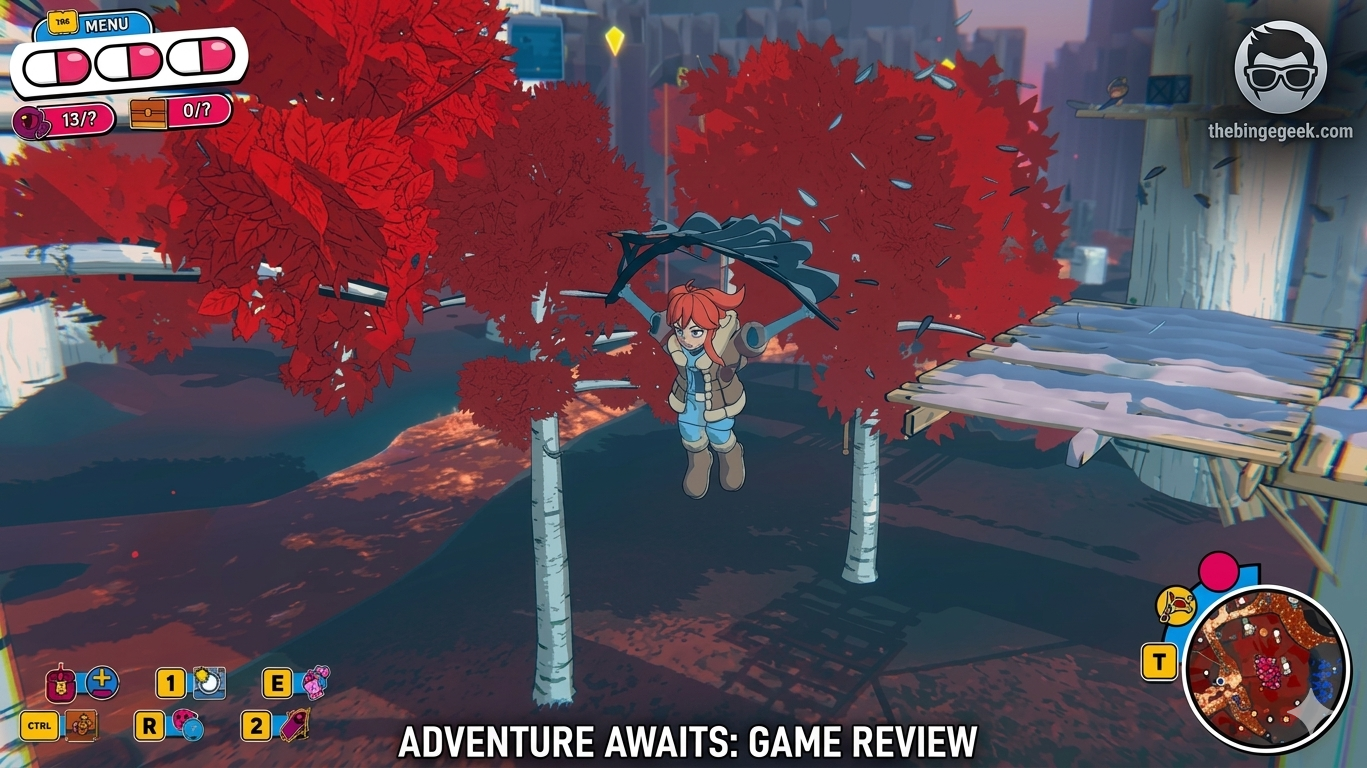
Demon Tides is a colorful and ambitious 3D platformer that has some great moments but also some very frustrating ones. The game clearly wants to bring back the magic of classic games like Banjo-Kazooie, Super Mario 64, Bowser’s Fury, Spyro the Dragon, and Croc: Legend of the Gobbos. This is a genre that hasn’t been able to find its place in recent years. It sometimes has that nostalgic charm, but it also has a lot of the same problems that modern players don’t have as much patience for.
A Promising but Uneven Gameplay Foundation
From the start, Demon Tides has a strong movement system. Players can almost immediately jump, dash, spin, flip, and grind, which gives them a sense of freedom and the chance to try new things. This depth looks great on paper, and it encourages players to learn new combinations and improve their playstyle over time.
But the design doesn’t always match the execution. Movement chaining often feels clunky because the transitions are awkward and the input timing is too strict. People often get in trouble for small mistakes, like pressing a button too many times, more than they should, which messes up the flow.
The spin-dive ability is one of the most annoying mechanics. Once it starts, it can’t be stopped, so players are stuck in the animation even if it makes a clear mistake. Things like accidentally launching off a high platform become too punishing, breaking the flow and immersion.
Ambitious Mechanics That Don’t Fully Connect
The game has a lot of different mechanics, like turning into a snake to swim faster, using bombs to break things, gliding over icy ground, and interacting with darker things in Ragnar’s Castle. These ideas show how creative and ambitious the game is.
Even so, the systems don’t always feel like they work together. Each mechanic is interesting on its own, but they don’t always work well together to create a single experience. When everything works together, movement feels fast, smooth, and good, but those times don’t happen all the time.
A Simple Story That Takes a Backseat
Demon Tides doesn’t leave a strong impression in terms of story. Beebz and her crew are trying to see the Demon King, but things go wrong on their journey and things get crazy. There are three parts to the world, and players must beat the main bosses—Jester, Tridentarius, and Roc—to bring things back into balance and unlock the final battle with Ragnar.
The premise is okay, but it mostly exists to support the gameplay instead of being its own thing. The structure is more linear than it seems at first, leading players through a controlled progression even though the world is open.
Exploration is the Game’s Strongest Feature
Demon Tides is at its best when it comes to exploring. The ocean is huge and has hidden islands, environmental puzzles, and secrets that are worth finding. Each island is its own challenge that makes players try out their skills.
The game doesn’t hold your hand too much, which makes you feel like you’re discovering something. But this design choice can sometimes make things confusing because goals aren’t always clearly stated.
A flexible checkpoint system lets players put flags for retries, but it can be boring to go back and forth because there is no fast travel. Rope shortcuts help with this, but it can still get boring to cross long distances of open water.
Progression System Offers Depth but Lacks Balance
Collecting Talismans is the main way to level up in the game. These improvements can change the way the game is played in big ways, making characters stronger and better overall. Players can also buy extra Talismans and open new slots by beating bosses.
This system lets you customize things, but it also makes things less balanced. Once players find strong combinations, a lot of challenges get a lot easier. If players have optimized their build, late-game sections can feel less exciting because skill-based platforming isn’t as important.
Camera Issues and Inconsistent Difficulty
The camera is one of the things that always goes wrong in the game. Bad positioning and things in the environment that get in the way often make it hard to see, which turns simple platforming into annoying obstacles.
This problem is made worse by the fact that the difficulty is not always the same. Some parts are too easy, while others are frustrating because of mechanics that don’t work well instead of real challenges. This imbalance often hurts things like jumping walls, changing gravity, and moving platforms.
Uninspired and Repetitive Boss Fights
Boss fights don’t have the same level of creativity as classic platformers. Most fights follow a set pattern of dodging attacks, waiting for a chance, and then hitting back. They work, but they’re not very creative and don’t stick in your mind very often.
These fights feel basic and repetitive compared to the creative boss designs in games like Crash Bandicoot.
Strong Visual Identity and Community Features
Demon Tides has a lot of different environments that make it stand out. From neon-lit refineries to icy caves and creepy abandoned places, each island has its own look. This variety makes exploration fun to look at and rewarding.
The game also has a shared graffiti system, like in Death Stranding, that lets players leave hints and messages for other players. This feature gives the game a sense of community, and some markings really do help players find their way.
Water races against AI or other players’ times are some of the extra activities that add content and make the game more fun to play again.
Final Verdict – A Fun but Flawed Platformer
Demon Tides is a game with a lot of ideas, creativity, and possibilities. At its best, it has exciting movement and rewarding exploration that are true to the spirit of classic platformers. But it can’t reach its full potential because of problems with the mechanics, the camera, and the balance.
This is a fun experience, but it takes some time to get used to it. There is always one moment that stands out and one that seems pointless. In the end, Demon Tides is a fun but flawed attempt to bring back a popular genre.