
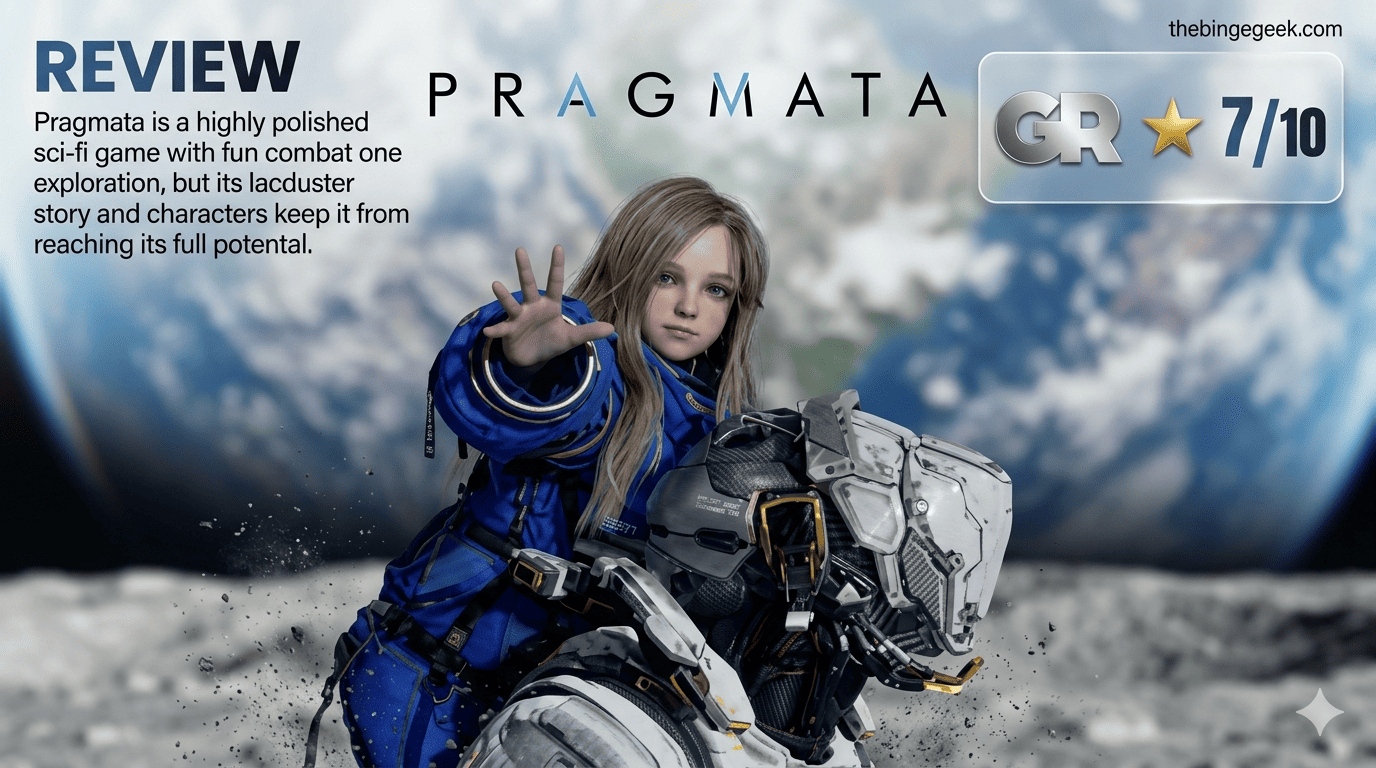
Once again this year, Capcom has shown why it is one of the most reliable names in gaming from all the major AAA studios. After the success of Resident Evil: Requiem and Monster Hunter Stories 3: Twisted Reflection, the studio has launched a new IP with Pragmata—and it might be their best release so far.
Pragmata is a sci-fi adventure that you’ll never forget, blending a heartfelt story with brand-new combat gameplay. The game has a moving father-daughter relationship between Diana and Hugh and mixes emotional storytelling with high-octane action to create an experience that feels like a love child of Dead Space and The Last of Us but one that has its own identity.
A Mystery of the Moon
The story centers around Hugh, a worker dispatched into space to repair a research station on the Moon after contact with Earth is suddenly lost. When Hugh is separated from his crew and stranded in a hostile environment, what starts out as a routine mission quickly turns into a fight for survival.
The colony’s mysterious AI system, IDUS, soon proves to be a major threat. Hugh meets Diana, a childlike android, and her innocence and curiosity immediately shift his priorities as he tries to survive. As a team they embark on a quest to uncover the truth about the colony and stop IDUS before it is too late.
As the story progresses, players learn more about the station’s secrets through dialogue, environmental storytelling, quieter moments between characters, and a well-paced story. Hugh and Diana’s discussions about Earth provide emotional heft and nice relief from the combat-heavy sections.
Powerful Characters Drive the Action
Pragmata maintains many of its biggest secrets until the final act, building tension around the mystery of IDUS for most of the campaign. Some of the late-game reveals may not be a total reinvention of the wheel for the genre, but the emotional payoff is where it hits home.
The strongest narrative element of the game is easily the relationship between Hugh and Diana. Diana views the world through the eyes of a child, Hugh is naturally cast as a protective father figure.
Some players might question the speed at which Hugh gets over the loss of his crew, and a couple of extra scenes dealing with his grief might have aided his character development. But it’s becoming more and more clear that Hugh is hiding his feelings for the sake of Diana, and there is an implicit emotional tension to their voyage.
A Combat System That’s Fresh
The story is interesting, but it’s the gameplay that really makes Pragmata shine.
Hugh has a large collection of weapons, divided into different categories of combat. The players can equip powerful offensive weapons, tactical support tools, and defensive units designed for battlefield control.
What makes combat unique is Diana’s hacking system.
Most enemies have heavy armor, so you can’t hit head-on. Players need to lock onto enemies and trigger a real-time hacking grid to reveal weak points. If Diana makes it through the grid, she will be able to disable shields, apply bonus damage and gain other tactical benefits.
Hugh hacks enemies, and he has a limited time to do as much damage as possible before having to do it again.
The result is a combat system that feels strategic, rewarding and surprisingly smooth. Even against faster enemies the mechanics feel intuitive and satisfying.
Minor balance problems
Of course, Pragmata’s combat design is impressive, but there are some minor balancing issues.
Some environments allow players to take advantage of vertical positioning. Some encounters are easier than they should be with raised platforms, ledges and containers, especially with long range damage upgrades.
The game does try to mitigate these opportunities in later encounters, but it is still one of the few glaring flaws in an otherwise polished combat system.
Lots of Enemy Diversity
Pragmata has a lot of enemies to throw at you in its 8 to 12 hour campaign.
Players will meet:
Standard robotic soldiers.
Huge androids like titans
Drone Flight
Attack shielded units
Tank armed with missiles
Hunters, great, shell-like
Every encounter brings new challenges, so combat never feels repetitive.
Six unique and beautifully designed environments
Pragmata has 6 distinct sectors, each with fresh visual design, atmosphere and gameplay opportunities.
The Moon colony is powered by a rare mineral called Lunum that enables scientists to 3D-print structures and environments. This results in some very creative level design.
Players will experience:
Replica of city streets inspired by New York City
Research institutions in industry
Underground mine facilities
Horror corridors of the dead space type
Each location feels distinct, which keeps the game pacing strong from start to finish.
Significant Engagement and Collectibles
Exploration is always worth it.
Players can gather holographic REM memories to help Diana discover more about Earth, unlocking Cabin Tokens for upgrades and customization.
These collectibles are more than just rewards; they enhance the emotional bond between Hugh and Diana via optional interactions, mini-games, and personal moments.
Diana could draw pictures, or play games, or just sit with Hugh quietly, making it a really warm experience.
The Shelter Hub Adds a Layer
Players return to The Shelter, the hub where they can, when not on missions:
Improve equipment
Unlock costumes
Full training simulations
Spend some time with Diana
Trade Cabin Tokens for collectibles and rewards
There’s also a bingo-style unlocking system that adds another layer of progression, encouraging players to fully explore each mission.
Excellent Presentation
Pragmata’s art direction deserves major props.
The Moon is naturally grey, but the dev team throws in enough color, architecture and environmental variety to keep each area visually engaging.
Environmental storytelling is also huge here, with holograms, logs and pieces of scattered data to tell the colony’s history.
The soundtrack fits the experience perfectly. The shelter sections are interspersed with calm, emotive tracks that make a beautiful contrast with the intense, synth-driven battle music, giving a strong emotional rhythm to the whole adventure.
Final Conclusion
So what makes Pragmata work? Well, it takes innovative gameplay, solid world-building, and emotionally driven storytelling and mashes them together into one complete package.
The emotional heart of the experience is Hugh and Diana’s relationship, and the hacking-based combat system ensures each encounter is meaningful.