
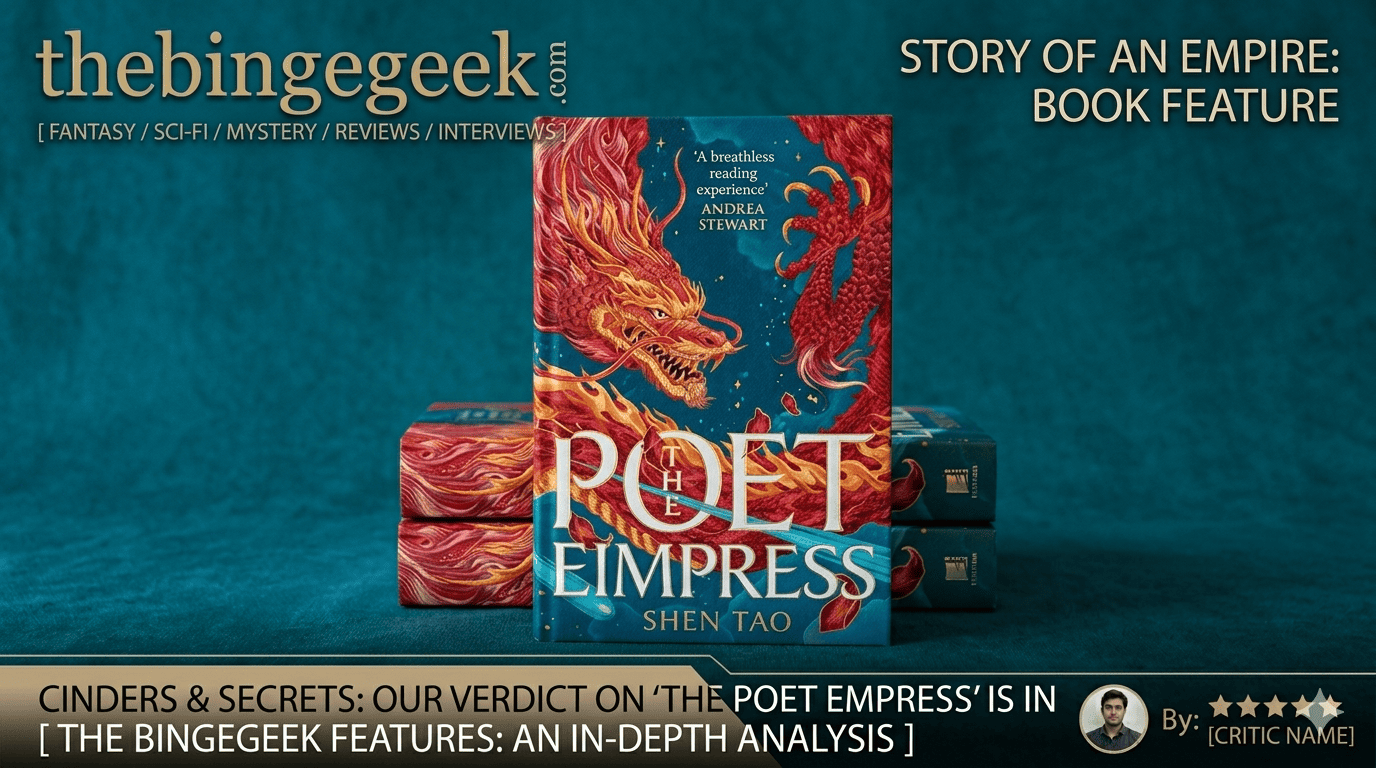
Meta Description
The Poet Empress by Shen Tao mixes political warfare, dark magic, and emotional manipulation into one of 2026’s standout fantasy debuts.
- Introduction
The last few years have seen fantasy readers hunting for the next great political epic, tales of betrayal, morally broken characters and kingdoms falling apart at the seams because of greed. The Poet Empress by Shen Tao comes with all of those expectations and, miraculously, it almost lives up to every bit of the hype surrounding it.
This is an incredibly ambitious book for a first-time stand-alone novel. It combines palace politics, ancient poetry-based magic, dynastic warfare and psychological manipulation into a story that rarely lets up long enough for readers to catch their breath. The Poet Empress isn’t perfect, but it does something that many modern fantasy novels don’t: it knows how to keep the reader emotionally stuck in its world.
And it’s hard to walk away once it grabs you.
A Kingdom in Decay From Within
Tensha’s world is presented as a nation on the verge of collapse. Famine is ravaging the villages, war is draining the resources, and the ruling Azalea Dynasty is too busy fighting over succession to care about the people who are suffering under them.
The chaos focuses on the dying emperor and the vicious struggle of his heirs. Every prince, advisor and faction of royalty seems ready to destroy the kingdom in order to get the throne first.
It’s the sense of the personal that makes the political struggle compelling. Tao avoids treating the war as a distant backdrop. Instead, the tension spills directly into the lives of ordinary people, especially Yin Wei, a farmer’s daughter whose desperation drives her into the royal court.
Wei does not come to the palace seeking destiny or heroism. She comes in because her village is starving.
That grounded motivation immediately sets her apart from many fantasy protagonists, who are written as “chosen saviors.” Wei survives because he’s adaptable, because he watches people closely, because he knows morality gets murky when survival is concerned.
Yin Wei is no traditional hero
One of the great strengths of the novel is the lead character.
Wei is smart, perceptive and emotionally tough, but Shen Tao wisely does not make her too noble. The more she becomes entangled in palace intrigues, the more she changes. Power seduces her little by little and the novel never shies away from the psychological price of manipulation and ambition.
There are shades of modern grimdark protagonists in her characterisation, especially in the way she rationalises more and more dangerous decisions to herself. Readers may start out cheering for her as an underdog, but the story slowly turns that support into doubt.
One of the most interesting aspects of the book is this moral tension.
Wei is always on the edge between victim and actor. She is a victim of the cruelty of the royal system, but she does learn how to use it as a weapon for her own survival.
This gives us a protagonist that feels painfully real, not idealized.
Real Hook of the Novel: Prince Terren
Prince Guan Terren looks almost cartoonishly cruel on first glance. In the early sections, he is painted as a violent heir, with fear, rumors and bloodshed all around him. Readers are invited to mistrust him at once.
But it’s when the story starts to peel back the layers behind his brutality that The Poet Empress becomes far more interesting.
The non-linear narrative of the novel reveals fragments of Terren’s past in bits and pieces. Advisors, servants, insiders at the royal court and political enemies all have different tales to tell about who he really is. Shen Tao gradually develops him into a disturbingly tragic figure rather than a simple villain.
That switch changes the emotional energy of the second half entirely.
Wei and Terren’s relationship moves from romance to psychological warfare, dependency, pity and manipulation. Importantly, the novel does not forget Terren’s cruelty. But just as readers start to feel sorry for him, Shen Tao reminds them why he was feared in the first place.
That emotional push and pull is what gives the story its sharpest edge.
The last act may leave readers conflicted in ways they never thought possible.
Poetry as Magic: Even When Confusing, It Still Feels Fresh
The fantasy genre is always on the lookout for unique magic systems and The Poet Empress certainly scores points for originality. Poetry itself is powerful in the world. Sigils, royal bloodlines. Blessed, some, with supernatural forces, through poetry.
It’s beautiful, in theory.
The imagery of the magic system is so dreamlike that the novel itself is under a spell, full of ghosts, dragons, echoes of the spirit and symbolic language. Shen Tao’s prose is often elegant without being exhausting, striking a balance between accessibility and vivid world-building.
But the mechanics behind the magic are sometimes maddeningly opaque.
The differences between sigil blessings, poetry powers and spiritual manifestations are not always completely explained. Some supernatural elements—especially the ghost and magical inheritance elements—are deliberately mysterious but, at times, the vagueness diminishes the stakes in major scenes.
Fortunately, the emotional storytelling is still strong enough that many readers will forgive the inconsistencies.
Even when the rules are blurred the world remains immersive.
Supporting Cast Adds Weight to Political Drama
The novel is at its best when paranoia descends on the royal court.
Characters like the disgraced former heir Maro and Chief Advisor Hesin add complexity to the succession war. Nobody has pure motives, and nearly every alliance has a temporary feel.
Maro is particularly interesting for how duty is the engine of his downfall. He is not as ruthlessly open as some of the other players in the palace, but he often feels trapped by obligation and tradition. Shen Tao repeatedly looks at the question of whether loyalty is a fault in corrupt systems.
But not all characters receive equal attention.
Empress Sun commands a huge narrative presence whenever she appears, but the novel rarely explores her perspective. Her development is limited and it feels like a missed opportunity given how influential she is to the broader political conflict. The same could be said for a number of female politicians who are more obstacles than fully fleshed out players.
It’s one of the few places where the story feels a bit choppy.
The Pacing Never Lets Up
One reason The Poet Empress has resonated so powerfully with readers online is its relentless momentum.
As a standalone novel, Shen Tao avoids the excessive filler that often afflicts sprawling fantasy series. Almost every chapter brings revelations, betrayals and emotional shifts that propel the story forward.
The non-linear structure adds suspense as well. Flashbacks, and historical memories, are not randomly placed, they are to reconfigure how readers see the present.
That constant re-assessment keeps the story interesting even when the political talk fades.
And while the novel does have romance-adjacent tension, readers looking for a traditional fantasy romance will need to recalibrate their expectations early on. There is love in the story but it is often not comforting. Most often it becomes a further source of vulnerability and destruction.
Final Verdict
The Poet Empress is not a perfect novel but it certainly lives up to its reputation as one of 2026’s most impressive fantasy debuts.
Shen Tao makes a dark, emotionally charged political fantasy that mixes palace intrigue with morally ambiguous character work and haunting magical ideas. The world-building at times leaves too many questions unanswered and some of the supporting characters could have done with a little more exploration but the core story is engrossing from start to finish.
But more importantly, the novel relies on readers to sit with discomfort. There are no heroes, all round, and the emotional struggles go on long past the last page.
For those readers who enjoy their fantasy on the political side, full of manipulation, tragedy, and complex power plays, The Poet Empress is a no-brainer.
Rating: 4.5 out of 5